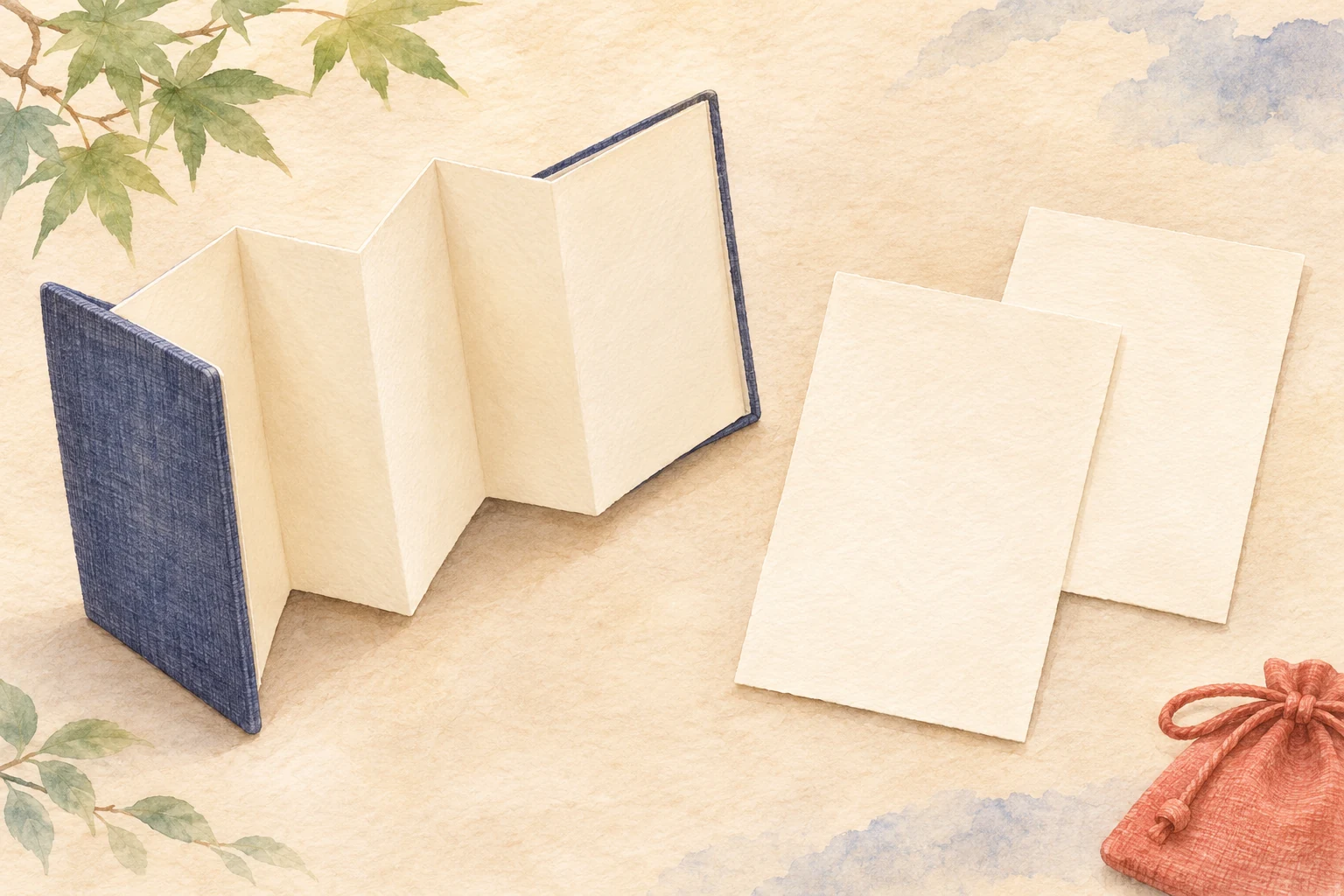
Kakioki goshuin are received on separate paper or a similar prepared sheet, rather than written directly in your book. A separate sheet is not necessarily printed. This guide explains the distinction and the checks that help you receive it calmly at the counter.
Kakioki and direct writing: where the goshuin is recorded
Jikagaki means writing directly in a book you bring, or another accepted writing surface. With kakioki, you receive a separate prepared sheet. Ujigami Shrine's official guidance describes kakioki as handing over paper bearing the goshuin.
Even with a book, your chosen design may be offered only on a separate sheet. Some places also lack paper options for visitors who forgot their books. Do not assume that you can always choose a format or receive a goshuin without a book; check the site's instructions.
Separate the format from the way it is made.
Kakioki is handed over as a separate sheet. Check the site's explanation to distinguish handwriting, printing and paper-cut work.
- Format
- Directly in a book or on paper
- How it is made
- Check handwriting or printing separately
- On the day
- Confirm your design and reception
Are separate sheets always printed? Handwritten, printed and paper-cut examples
The term kakioki does not tell you exactly how it was made. Hongo Hikawa Shrine states that its separate sheets, too, are handwritten and stamped. Kannonji Temple in Tsushima explains that its kakioki designs are printed except for the red seal. These are each location's own descriptions.
Sarutahiko Shrine in Suginami, Tokyo, lists its paper-cut and illustrated goshuin as separate-sheet formats only. Sheet dimensions and processing can differ, so the name alone does not establish a common specification.
Do not use the distinction between direct writing and separate sheets to declare a hierarchy of spiritual benefit or value. Treat the goshuin with care as a record of worship and respect the issuing site's approach.
One shrine, different designs and conditions: the Ujigami example
Ujigami Shrine's official page says that only its standard black-ink goshuin can be written in a book; its colored-paper versions are intended for mounting by the recipient. It also explains that separate sheets are provided when the writer is unavailable. The summary below compares the stated formats, rather than photographs of actual items.
The shrine also says that the starting time for writing in books varies by day. A reception counter's opening time therefore should not automatically be treated as the start of direct writing. Follow the latest information and instructions on the day.
- Standard black-ink goshuin
- Listed as eligible for writing in a book
- Colored-paper goshuin
- Described as a format the recipient mounts
- When the writer is absent
- Separate sheets are offered instead
Summary of Ujigami Shrine's official guidance, checked 14 November 2026. This does not guarantee reception on the day.
Before visiting: check the design, format and reception
Read the official goshuin page and recent notices for the format of your chosen design, reception dates and hours, and any end-of-issue notice. Distinguish visiting hours from the hours when goshuin are issued.
Sites may use terms such as kami-shuin or goshuin-fu. Read the explanation of whether you receive paper or leave a book, rather than relying on the term alone. Check the offering amount and payment method for that particular design as well.
If direct writing is unavailable, avoid rushing the writer or insisting on a service outside the published guidance.
Keep a separate sheet flat and dry on the way home
Specify your chosen design and confirm that it will be handed over on paper. Ask about any instructions concerning the date, backing or protective sheets. Procedures and waiting times vary; a separate sheet does not guarantee an immediate handover.
As a practical preparation, you can bring a flat case or protective sleeve that fits the paper comfortably. Check its dimensions and avoid forcing it into a small pocket, folding it sharply or packing it with wet items.
If the ink is still damp or protective paper accompanies a paper-cut design, follow the counter's handling instructions. The suggested carrying items are editorial advice, rather than a universal requirement for every goshuin.
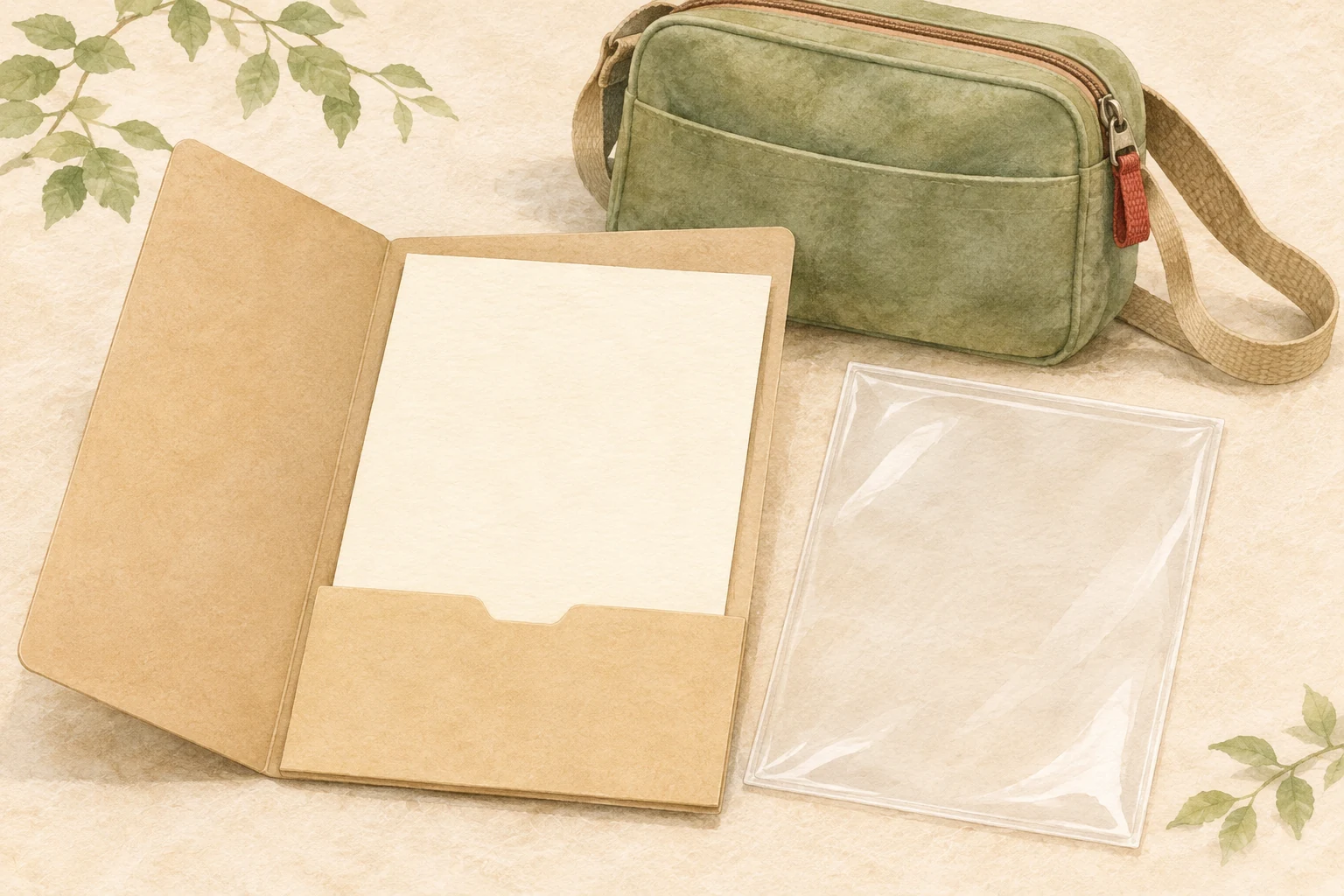
A small check before taking paper home
- Bring a flat case that fits the sheet comfortably.
- Avoid folds, water and rubbing the surface.
- Ask how to handle any backing or protective sheets.
At home: decide between mounting and storing
A separate sheet can be mounted in a book, or stored in a pocket-style book with suitable dimensions. First check the sheet and backing, then decide how to keep it before cutting or attaching anything.
Adhesives, mounting steps and detailed long-term storage are outside this page's scope. Understanding the format and bringing the sheet home safely are useful first steps.
Official sources checked
- Ujigami Shrine: Goshuin (Japanese)
- Ujigami Shrine: Guidance for visitors (Japanese)
- Hongo Hikawa Shrine: Goshuin (Japanese)
- Sarutahiko Shrine, Suginami: Goshuin (Japanese)
- Kannonji Temple, Tsushima: Separate-sheet goshuin (Japanese)
- Miyagi Prefecture's Association of Shinto Shrines: Goshuin etiquette (Japanese)
Official shrine, temple and association pages were checked for this guide. The examples describe the guidance found at that time, without guaranteeing availability, stock or reception on the day. Illustrations are explanatory artwork, not photographs of actual goshuin or evidence of a new site visit.